EL NIÑO EVENTS

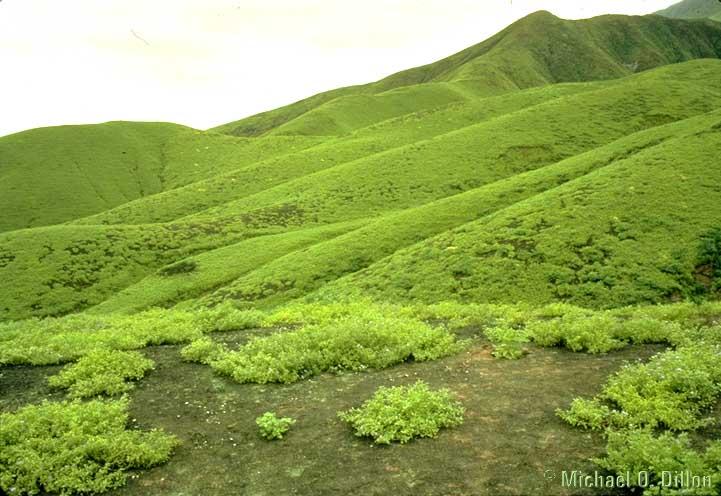
In our search for the forces and processes that act upon Nolana and the coastal desert regions, it can be argued that short-term climatic fluctuations of El Niño events (5--50 year cycles) are an important seasonal influence on the coastal region. The physics behind the El Niño Southern Oscillation (ENSO) phenomenon is complex and represents a worldwide weather perturbation. El Niño conditions prevail when the normally cold waters of the coast of western South America are displaced by a warmer, western Pacific surface and subsurface body of water that stimulates brief periods of heavy rainfall (Fig. 1) and relatively high temperatures. This influx of available moisture has profound effects within the lomas formations (Fig. 2) and has undoubtedly helped shape their composition and structure. Primarily, this moisture stimulates massive germination of seeds leading to large blooming events that replenish seed banks for annual and perennial plants. These events also provide opportunities for seed dispersal and establishment, which would expand distributions under favorable conditions. When the arid conditions return after an ENSO event, annual and perennial plants dry up rapidly.
The impact of El Niños on these communities is obvious (Dillon & Rundel, 1990), and one can only wonder what the coastal vegetation would resemble in the absence of these conditions. Potentially, levels of floristic diversity would be much lower and migration and establishment more difficult. In the western Pacific, the reverse effects of recurrent droughts and rainfall variability have been implicated in the evolution of vegetation patterns in Australia (Nicholls, 1991). El Niño events have been recorded in both historical (Quinn & Neal, 1987) and Holocene periods (DeVries, 1987; Fontugne et al., 1999; Rodbell et al., 1999; Magilligan & Goldstein, 2001; Sandweiss et al., 1996, 1999, 2001). Longer-term records of El Niño events are more difficult to detect and interpret (Moseley, 1987). Recently, Hughen et al. (1999) have detected variability in growth patterns in fossil coral which they interpret as representing El Niño-like conditions may have existed for at least 124,000 years. Our studies of modern vegetation do not allow for estimations of the onset of El Niño conditions, but regardless of their age, they have undoubtedly played an important role in shaping the present coastal communities.

.jpg)
