
|
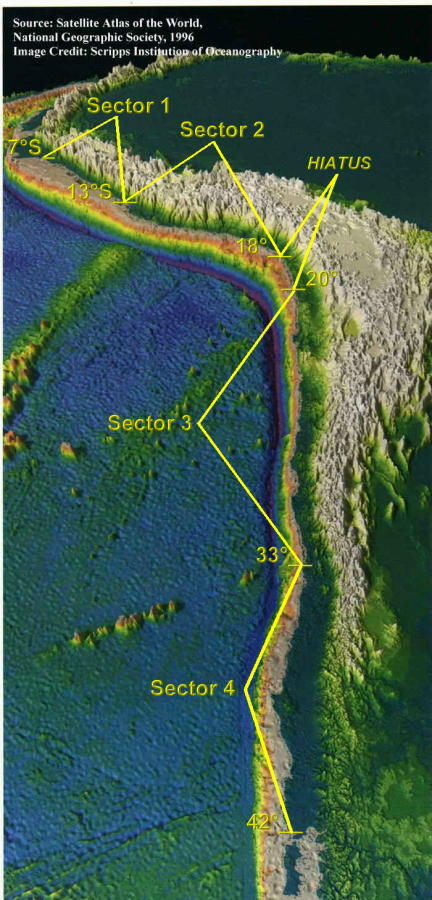
In the 3-D satellite map below, the modern coast line of South America is represented by the dark green strip at the western base of the Andean Cordillera, to the left, the continental margin is colored pink or beige, and the subduction trench is visable in deep blue. One of the processes which had an influence on the coastal flora is long-term climatic changes associated with glacial cycles (13,000 to 200,000 year cycles) throughout the Pleistocene. The formation of glaciers on mountain tops caused sea levels to fluctuate dramatically. Estimates of sea level lowering range from between 120-230 m and at its lowest level, the entirety of the continental margin (color pink or beige) would have been exposed land. This drop in sea level would have significantly altered the position of the modern seashore in relation to the Andean Cordillera and exposed the northern Peruvian continental shelf. This action would have most certainly displaced the plant communities between 50-100 kms, especially from 5° to 13° S latitude. South of 13°S latitude, the continental margin is narrow, with the subduction zone very near the base of the Andes. Here, populations could have shifted vertically, but maintained their contact with coastal cloud patterns. These changes provided opportunities for species to adapt to changing conditions in situ; migrate or shift with changing environments; or underwent range reductions and extinction. It is beleived that these events had a profound influence on the evolution of the flora and fauna of the coastal deserts by providing geographic isolation and opportunities for merging of populations and gene exchange. These forces are considered as a potential source of much of the species diversity in Nolana. Patterns of similarity within the overall flora of the lomas formations suggest non-uniform distribution of taxa within the coastal deserts of western South America. The distribution of Nolana species also reflects this pattern with three sectors within the coastal deserts with independent histories: Sector 1 - four (4) endemics in the northern Peruvian unit from 7°'S to 13°S latitude; Sector 2- 33 endemics in the Southern Peruvian unit from 13°S to 18°S latitude, and Sector 3 - 42 endemics in the northern Chilean unit from 20°S to 33°S [one taxon, Nolana paradoxa, ranges from 33'S to 42°30'S latitude [Sector 4]. Nolana galapagensis is endemic to the Galápagos Islands (Ecuador). The segment of coastal desert in extreme northern Chile, between 18° and 20° is nearly devoid of vegetation [HIATUS] and lacks the proper, near-shore topography to develop lomas communities (cf. Rundel et al., 1991). The greatest number of endemics are centered in Sector 2 and 3. Only four (4) Nolana species have distributions that span the 18° to 20°S hiatus: Nolana adansonii, N. gracillima, N. jaffuelii, and N. lycioides. |
|
 [Return to Nolana Supplement]
-- [Visit ABIS Homepage]
[Return to Nolana Supplement]
-- [Visit ABIS Homepage]