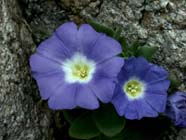
Nolaneae-Solanaceae

Michael O. Dillon
Department of Botany
Field Museum, Chicago, IL 60605 USA


INTRODUCTION

The vegetation of coastal Peru and northern Chile, termed "lomas" formations, is composed of floristic elements from various biogeographic sources [see Environments/Coastal Deserts]. The Nolana clade (Solanaceae-Nolaneae) stands out as the most wide-ranging and conspicuous floristic element of these formations; and the evolutionary history of Nolana may hold clues to age and origin of the coastal deserts. Members of the Nolana clade have traditionally been recognized at the familial (Nolanaceae) or subfamilial (Nolanoideae) rank due to its unusual carpel morphology , but chloroplast DNA restriction site mapping studies have recently placed Nolana L. within the family Solanaceae with closest relationships to Lycium L. and Grabowskia Schldl. in a clade that also contains Hyoscyamus L. and Atropa L. Our studies of the phylogenetic relationships within the Nolana clade include data from hybridization experiments, morphology, physiology, and molecular data from ITS sequencing. The establishment of a putative phylogeny for the Nolana clade provides a framework for testing hypotheses of character evolution and biogeography.

Of the many genera purposed within the Nolana clade, our preliminary data support the recognition of two subgenera, Nolana and Alona Lindl. In addition, our studies support the recognition of 80 species: 39 species from Peru, 40 species from Chile, at least 2 species are distributed in both Peru and Chile, and one species in the Galapagos Islands. Since 1983, field studies have been conducted throughout the range of the Nolana clade, and we have encountered several collections that may warrant formal taxonomic recognition from both Chile and Peru. Our studies point to northern Chile as the origin for the Nolana clade and examples of extensive secondary sympatry are recorded from that area. Evolution of diversity within this group must be viewed in the context of the climatic and geological changes within the deserts of coastal South America, including glacial cycles and sea-level changes, continental uplift, and global climate change, and the historical development of ENSO ("El Niņo") weather patterns.

Three sections with information are currently available, and include a selection of species with images, herbarium sheets for selected species, and type photographs taken by J.F. Macbride in Europe before 1940.

This portion of the site is actively under development.
Please return in the near future to view additional information.

Nolana Systematics

Examples of Nolana Herbarium Sheets

Examples of Macbride's European Type Photographs


[Return to Homepage] [Environments] [Plant Families] [Database Activities] [Publications]
[J. Francis Macbride & Flora of Peru Series] [Project Staff & Collaborators]